
What Do You Call Him Now
Jul 08, 2026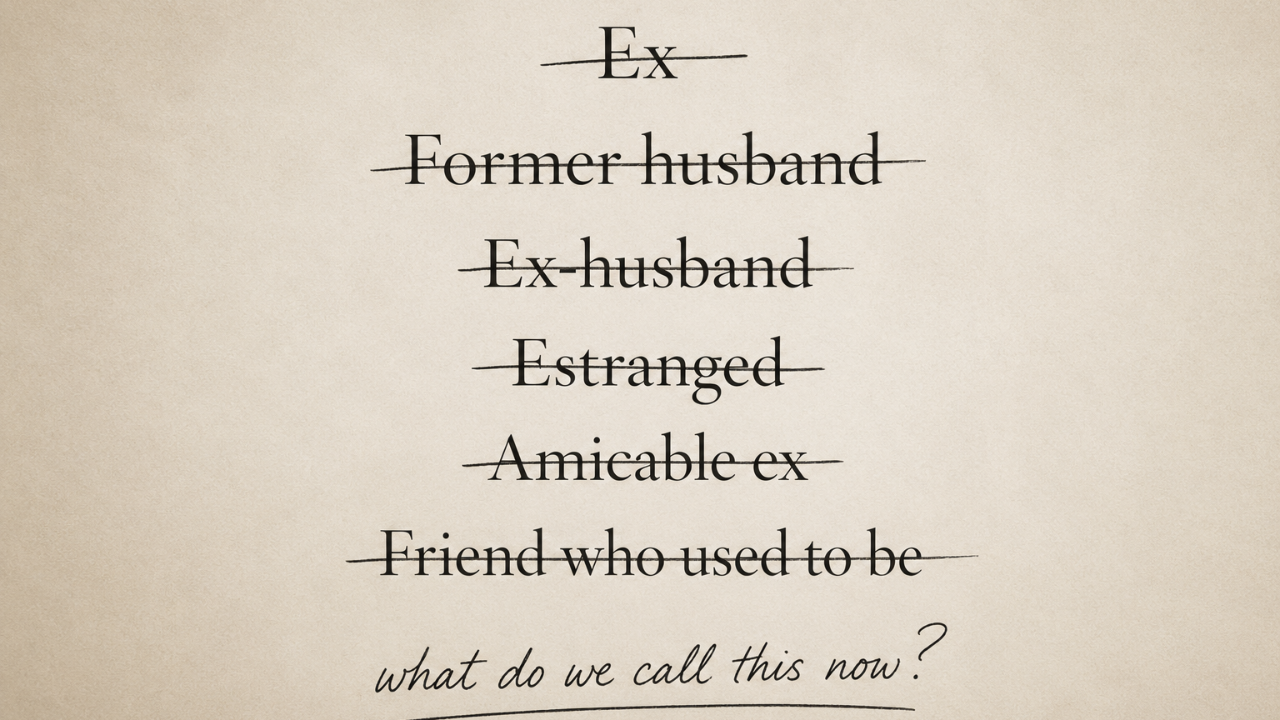
On the container we invented after the marriage ended
By Leslie K. Leland
You saw us together last week.
He was helping me move. I posted the moment because it was a real one. He carried boxes. I made him laugh. We talked about the healthcare company on the drive over. It looked, from the outside, like any other Monday between two people who care about each other.
The comments I got, both public and private, were some version of the same question.
What is that? What are you two to each other now?
I have not answered it in prose yet. I answered it on my album. There is a song called Still Partners that I wrote because I could not find the language in ordinary conversation for what we have become. Music let me name it before I could explain it. This essay is the explanation.
We do not have a word for it yet. That is the honest place to start.
What the Culture Gave Us
The vocabulary for post-marriage relationships is small, and it is mostly hostile.
Ex. Too small. Too dismissive. A word that closes a door and asks you to walk away from it.
Former husband. Better, but still past tense. He is not in my past. He is in my present. He is in my phone. He is in the ongoing business of the company we built together, which is still serving veterans, which was the whole point of the work.
Amicable exes. Amicable implies a truce between two people who would prefer not to see each other. We do not prefer not to see each other. We prefer to see each other. We just cannot be married.
Co-parents. No children between us.
Friends who used to be married. This one suggests we downgraded, and we did not. What we are now is not less than what we were. It is different than what we were.
None of the available words describe the actual thing. So when someone asks me casually, and the answer has to be one word, I stall. I say something vague. I let the conversation move on before I have to pick a word that will be wrong.
I have been thinking about why that is. And I think it is because the culture has an economic interest in a specific story about how marriages end. The story is that one person was the villain and one person was the victim. The story is that both parties are supposed to move on and forget. The story is that the healthiest thing to do is erase each other from the daily life you both built.
That story sells legal services. It sells coaching packages. It sells dating apps. It sells self-help books about closure. Closure is a very lucrative product.
But closure is not what I want with him. Closure is what you seek when the relationship failed and left you with a wound that needs to close so you can move on. Ours did not fail. It changed. It is not a wound. It is a doorway.
I do not want to close it. I want to walk through it into whatever comes next.
The Container
Here is what I have been thinking about for months. What we ended was the marriage. What we did not end was the relationship.
Most people conflate those two things. The culture teaches us that when a marriage ends, the relationship ends. That the two people become strangers by degrees. That the goal is polite distance at family weddings.
The marriage is a container. It is a specific legal, spiritual, and daily-life structure that holds two people in a particular shape. When you end the marriage, you end the container. You do not end the two people. You do not end whatever is between them. You end the shape it was being held in.
If the two people still have something between them and want to keep it, they have to invent a new container. There is no template. Nobody hands you the shape of the new container. You have to build it from scratch by paying attention to what feels honest and what feels like a slide backward.
That is the work we have been doing for the last year.
We are in each other's phones as Waleed and Leslie, not as anything cute. The nicknames from the marriage are gone. We renamed each other when we renamed the relationship.
We text about the business. We do not text about my personal life. That is a boundary I set for myself, not one he asked for.
We do not have dinner alone. We do not travel together, even for work. We do not text after 9 PM. Those are not walls. They are the shape of the new container. Without them, the risk is that the relationship gets confusing for both of us, and it takes months to recover.
He came to my sister's birthday party earlier this year. I am still close with his family. His sister and I still do business together. The connection between our families did not disappear when the marriage did. It got carried forward, in a different shape, into whatever this is becoming.
Every post-marriage relationship that continues is going to have to invent its own version of these lines. Nobody is going to give you the template. What worked for us will not work for you. What matters is that the container gets built consciously, not accidentally. You cannot leave the new relationship in the shape of the old one and expect it to hold.
The old shape has to go.
The new one has to be chosen.
Why We Kept the Company
I want to name why the business partnership continues, because I know that is the part that reads unusual from the outside.
I built the veteran healthcare company starting years before Waleed came on. He joined the company in 2024, bringing twenty-five years of institutional knowledge about how the government serves and fails veterans. That knowledge has been part of what has allowed us to keep growing and to keep serving over ten thousand veterans across thirty-one locations.
When we ended the marriage, we did not end the mission. The mission is bigger than the container it was living inside of.
A lot of divorced couples end the business alongside the marriage because they cannot separate the two. I understand why. It is hard. Some days it is impossibly hard. But we decided together that the veterans we serve did not need to lose their healthcare provider because their founder's marriage ended. That decision required us to build a business container that could hold the two of us as partners without collapsing back into the marital container.
That container has its own lines. Business meetings only. Written communication preferred. No decisions made when either of us is in a hard week emotionally. Third parties in the room for anything strategic. Regular check-ins on whether the container is still working.
It is working. Some days it is easier than others. On the days it is hard, we honor the hard by naming it and giving each other space. On the days it is easy, we do the work we set out to do.
The business is thriving. The veterans are getting served. Nobody who does not work in the company would know that the founders were once married, unless someone told them, because we do not perform the divorce inside the business, and we do not perform the business inside our personal lives.
Two containers. Not one. That is how it holds.
What I Am Asking You to Consider
If you are in a post-marriage relationship right now and you still love the person, and the culture keeps telling you that is not allowed, I want to say something to you directly.
It is allowed.
You are allowed to love someone you cannot be married to. You are allowed to speak about him warmly. You are allowed to keep him in your phone. You are allowed to build a post-marriage container that is honest and safe and different from what the culture has given you words for.
You are also allowed to have a container that looks nothing like mine. Some marriages need real distance to recover from. Some need silence. Some need years. There is no template. The only rule is that whatever container you build, you build it consciously, and you build it in service of both of you, not just one of you.
Divorce is one of the loneliest kinds of grief because the culture will not let you grieve it out loud. You are supposed to be relieved. You are supposed to be moving on. You are supposed to already be somewhere else.
You do not have to be.
You can be in the middle of a both/and that is not resolvable. You can love him and have left him. You can grieve him and be free of him. You can build a new container that holds what remains without pretending the old container never existed.
Nobody is going to give you permission. You are going to have to give it to yourself.
I am giving myself permission out loud, in writing, right now, so that if you are reading this and you have been waiting for someone to say it is okay, you have your evidence.
It is okay.
I am 53. I am divorced. I am still building a company with the man I used to be married to. I am also building a life without him in it romantically, and I do not know what the shape of that life is going to be yet.
Both things are true.
The word for what we are does not exist yet.
I am going to keep looking for it.
If you find it before I do, tell me.
— Leslie K. Leland
The Architect of Redemption™
© 2026 Leslie K. Leland / Shebizness LLC. All Rights Reserved. The Architect of Redemption™, The L.E.S.L.I.E. Framework™, Seasons Alignment™, and Strategic AI Partnership™ are trademarks of Leslie K. Leland. Lyrics referenced from Still Partners © 2026 Shebizness Publishing (BMI).
Stay connected with our monthly blog insights from Leslie!
Join our mailing list to receive the latest news and updates from our team.
Don't worry, your information will not be shared.
We hate SPAM. We will never sell your information, for any reason.